AI Is Not Technology, But A Tool For Business Transformation
While most companies still see AI as a “gadget”, IBM understands it as a key instrument for business transformation. Their AI-first approach does not mean that AI is an end in itself, but a trusted tool that changes the very core of business operations. So what does the shift from a “gadget” to real business transformation look like in practice? Hans-Petter Dalen explains through IBM’s own experience.
AI-First In Practice
IBM’s maturity in the field of artificial intelligence is almost unmatched, as the company has a long legacy of developing and applying these technologies. But AI-first does not mean putting this technology at the centre of things simply because it exists. The key is that AI must be secure and trusted. Every use case is assessed through a risk framework – what it means for the company, employees, clients, shareholders, and other stakeholders.
Today, most companies use AI as a personal productivity tool – for example, helping employees with everyday tasks. While useful, this does not represent a true business transformation. Analysts at Gartner, one of the world’s leading IT research authorities, have already warned that we must move AI from personal productivity into the core of business processes. And this requires much more: AI literacy across all departments – from finance to HR, from manufacturing to procurement. Only once each unit understands where AI can create value can we speak of a real transformation.
Ethics And AI
One of the greatest risks of AI lies in its scale. If a single employee makes a mistake, the consequences are limited. If the same mistake is made by an AI system without proper oversight, it can impact thousands of users. This is why every company needs a clear ethical framework. At the heart of this is the awareness that the main risks are related to trust, and that the misuse of AI can very quickly lead to a loss of trust in a company.
A case from Norway illustrates how easily this can happen. The city of Tromsø decided to close some schools and kindergartens due to a decline in the number of children. As parents expressed dissatisfaction, the municipality issued a report with explanations. The report contained incorrect references and even fabricated quotes attributed to real people. It later turned out the entire document had been generated by ChatGPT – without human review. The event was labelled an “AI scandal”, but in reality, it was a human scandal. Technology itself is neither good nor bad, and responsibility for its use always remains with people.
Regulation And AI
Regulation plays an important safeguarding role. With the AI Act, the European Union has introduced mandatory training for employees to understand artificial intelligence:
“Any company operating in the EU single market that uses AI must provide AI literacy training to its employees. This is a significant change. As a market, we will be much better at understanding what this technology is – and what it is not.”
The European framework is not complicated, since it does not regulate technology as such, but its use. The goal is consumer protection, which is also an ethical issue. In this way, the EU ensures that the rights of citizens come first. The U.S., on the other hand, has taken a very different approach. There are already more than 300 AI-related regulations in force and over 800 more in the pipeline, creating an extremely complex environment for companies operating across multiple states. Europe, by contrast, offers a single framework valid across all member states, which gives companies much greater clarity and predictability.
Who Will Win The AI Era?
The winners will be those companies that understand that AI is not technology, but a tool for business transformation. And if we focus only on the tools – whether it’s Copilot, Bedrock, or something else – we miss the point. It doesn’t matter which brand of screwdriver you use, what matters is that you use it in the right place.
Ninety-five percent of generative AI experiments never make it out of the sandbox, and Gartner predicts that by 2027 as many as 40% of AI projects will fail. The reason is that companies still see AI as a technology instead of as a tool for creating added value. The key will be raising AI literacy and giving each department enough autonomy to recognise where AI can truly make a difference.
An Opportunity For Smaller Companies
AI will not necessarily turn small companies into large ones. But it will help them become more agile, more profitable, and faster in moving from innovation to execution. Large corporations have complex governance frameworks, while smaller businesses can use AI to create value much more quickly.
Small companies do not need to develop or host AI on their own. There are many partners who can build and operate use cases for them. But the key is the same as for large systems: AI literacy.
The greatest value of generative AI is not automation, but additional business value. If small businesses apply it in sales, marketing, or customer support, they can generate outstanding results. This technology does not replace human intelligence – it augments it. If small companies understand the potential of AI and use it in their core processes, they can create value that goes far beyond personal productivity. This, however, requires understanding where AI can help, and the courage to overcome fear of the technology.
AI for Business – IBM’s Experience and Solutions
1. Responsible Ai As A Competitive Advantage
Responsible AI is not just a regulatory necessity – it is also good for business. Building trust and transparency strengthens relationships with clients, leading to better business outcomes. The key question is not whether to regulate, but where to regulate. The focus must be on use cases and risks, not the technology itself.
2. IBM As “Client Zero”
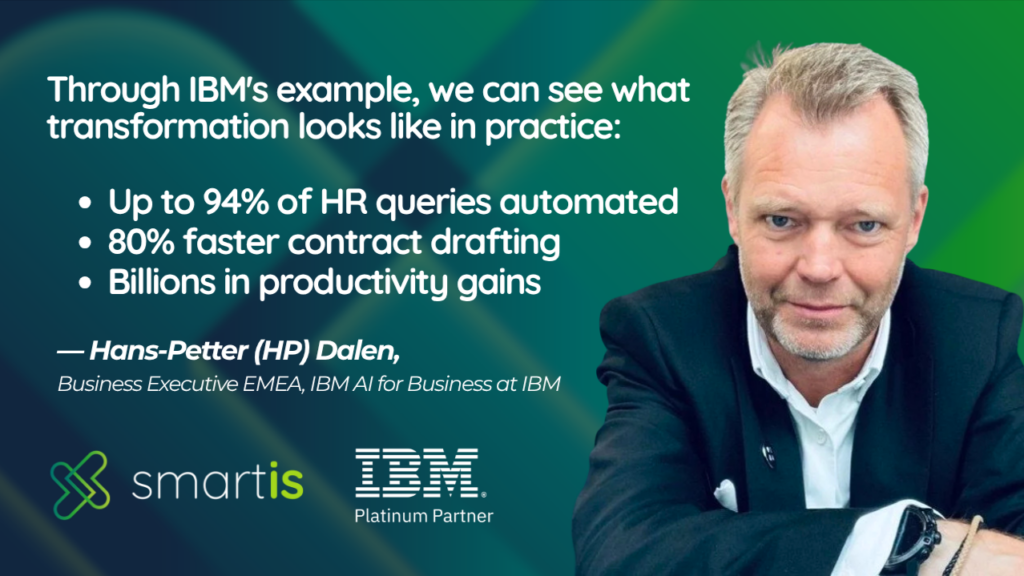
IBM has long used its own AI solutions, proving their value in practice. The “client zero” concept means the company tests and optimises solutions internally before offering them to clients. The results are impressive:
94% of basic HR queries are now handled by an AI assistant,
contract drafting time has been reduced by 80%,
since early 2023, IBM has achieved approximately $3.5 billion in productivity savings.
3. Watsonx – IBM’s Ai Portfolio
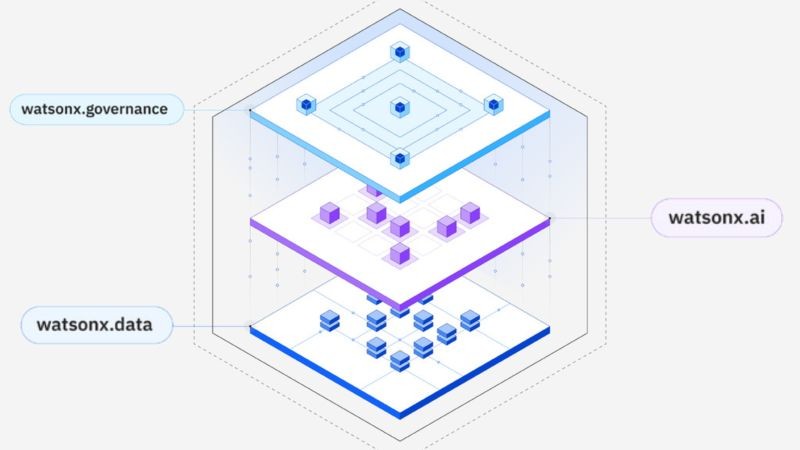
Watsonx is IBM’s flagship AI portfolio, designed to accelerate the adoption of generative AI in business processes. Key modules include:
- watsonx.ai: an end-to-end environment for building and deploying AI solutions,
- watsonx.data: an open, hybrid data lakehouse enabling access to all data, anywhere,
- watsonx.governance: a toolkit for managing risks, compliance, and the full AI lifecycle,
- watsonx Orchestrate: a solution for creating and managing AI agents to automate workflows,
- watsonx Assistants: applications that use generative AI to automate workflows, from customer service to HR and code development.
4. An Open And Trusted Ai Future
IBM believes in an open innovation ecosystem. The future of AI will be based on open-source approaches that ensure safety, transparency, and accessibility.
All solutions are built with trust in mind: free of harmful bias, explainable, and compliant with regulations. Client data remains secure, and control always stays in the hands of the client.
IBM’s Experience With Askhr
With the introduction of the AskHR agent, IBM has automated as much as 96% of all HR processes. The agent enables employees to be fully self-sufficient in handling HR matters, while also acting as an interface between employees and complex back-end systems.
When IBM switched from Workday to SAP SuccessFactors earlier this year, 80% of employees did not need any training on the new system – because they never work with it directly. Their interface remains the agent, which does everything for them.
“Agentic AI” has the potential to transform every existing front-end system into a back-end, where the agent becomes the main interface. This dramatically improves efficiency and satisfaction.
Managers were initially sceptical, believing they would lose support from their HR partners. Today, however, they realise the agent takes over routine tasks, while HR partners can focus on strategic questions – developing competencies, building culture, and training. As one manager puts it: “Even requesting a vacation has become a joy. The agent does it all for me.”
Who Is Hans-Petter (HP) Dalen?
Hans-Petter (HP) Dalen leads IBM’s AI Governance initiative in the EMEA region. He has been with IBM for 23 years, at the heart of many technological breakthroughs. He began his career in user support at a Norwegian telecoms company, then joined Lotus Development and later IBM, where he worked in analytics, advanced analytics, and big data.

As an expert in AI governance, he helps companies ensure compliance, protect their reputation, and leverage the competitive advantages of AI. His mission today is clear: to help businesses understand how to use AI safely, responsibly, and in line with regulation – and how to turn it from a technology into a true tool for business transformation.