THE FUTURE OF IT IN SLOVENIA: TALENT, TRANSFORMATION, AND SUSTAINABILITY
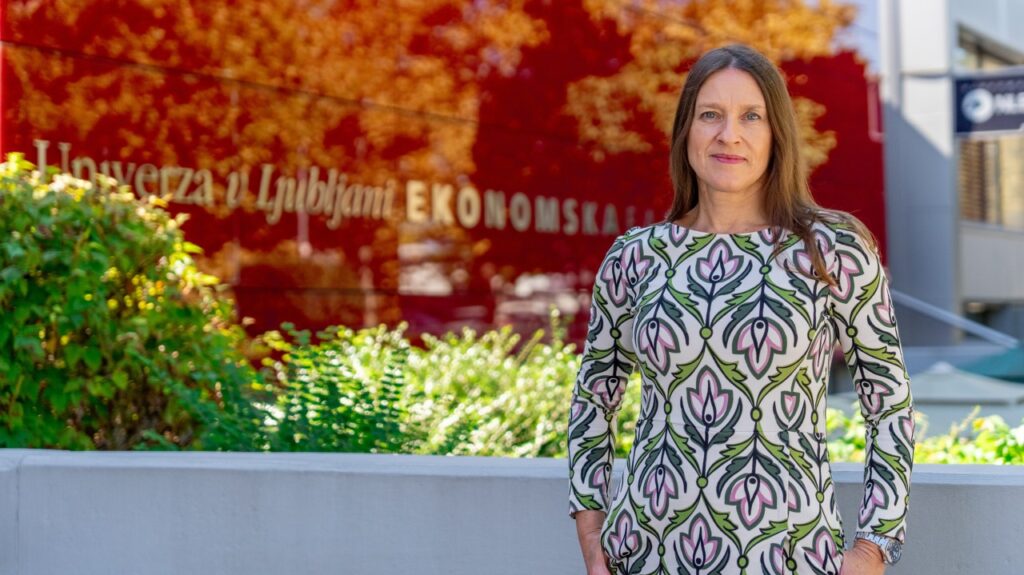
Interview with Prof. Dr Adriana Rejc Buhovac, School of Economics and Business, University of Ljubljana
How to attract and retain the best IT talent? More than ever, top experts are driven by real challenges – from innovative, international projects to working with cutting-edge programming languages and emerging technologies.
Equally important are modern work conditions: flexible schedules, hybrid-work options, and shorter workdays. Freedom is becoming a key factor as well – such as the possibility of extended leave, for example a sabbatical. This topic was explored in conversation with Prof. Dr Adriana Rejc Buhovac from the School of Economics and Business, University of Ljubljana, an expert in strategic management and socially responsible business, who has for many years worked with domestic and international companies on strategy development and sustainable transformation.
Slovenia is experiencing a major shortage of IT experts. How much does this affect its digital future?
The shortage of IT professionals is not only a Slovenian challenge, but a global one. Its severity has increased due to cybersecurity risks driven by economic and political interests. Today, digital resilience is often decisive for ensuring uninterrupted business operations.
There are many potential solutions, but what we need is political and societal will. A key priority is expanding enrolment in IT and computer science studies, as well as the development of micro-credentials. For example, the Faculty of Computer and Information Science in Ljubljana has already launched a DevOps micro-credential and awarded the first certificates, and we need more initiatives of this kind. Digital competencies – including programming – should be integrated across all education programmes, beginning with primary school.
IT talent isn’t created only at universities – it’s also about talent, mindset, and skills. Companies need to reassess the workload within their IT departments. Often, tasks can be redistributed more effectively so that experienced developers are not burdened with routine operations. Generative AI offers substantial potential here, while part of the workload can be handled by colleagues without specialised technical expertise. It is essential that companies invest in employee development, which can be done through co-financed reskilling, training programmes, student internships, and other forms of competency building.
How can HR strategy help companies retain top talent and prevent brain drain?
The first step is understanding what really motivates people. And the simplest way to find out is to ask. It is often assumed that the key motivators are higher salaries or different forms of variable compensation, such as monthly performance bonuses, rewards for successfully completed projects, or even profit-sharing. But in practice, that’s not always the most important factor.
My experience shows that for many professionals, exciting challenges are just as important, if not more so. That means innovative international projects, work with cutting-edge programming languages and emerging technologies. Working conditions also play a major role: flexible schedules, hybrid and remote work options, and even shorter workdays. Freedom is equally important – such as the possibility of extended leave, like a sabbatical.
»I’ve had the opportunity to work with many excellent Slovenian IT companies, and Smartis is certainly one worth highlighting. What impresses me most is the number of bright and dedicated colleagues there, as well as the attitude of the leadership” says Prof. Dr Adriana Rejc Buhovac.«
Should companies see IT as a support function, or as a strategic core of the business?
As a consultant in strategy development and sustainable transformation, I have worked on more than 100 projects. Digitalisation was integrated into almost every corporate or business strategy – whether at the level of processes, new products and services, or business models.
The role of IT will become increasingly strategic. This means that companies can no longer treat digitalisation merely as support, but instead as a core driver of development. That’s why it’s crucial for Slovenian companies to have reliable, strategy-driven local IT partners who understand the specifics of the domestic market and the broader national context.
Where do you see the biggest opportunities for Slovenian companies in digital transformation?
There are numerous opportunities, so I’d like to focus on the areas that I consider most important.
First, regulatory demands related to sustainability and operational traceability. IT support is crucial here – from digital control of resource consumption, warehouse operations, and tracking the movement of semi-finished and finished products, to more advanced AI-driven solutions that enable better planning of consumption, maintenance, and production. Today, even small and medium-sized enterprises urgently need support in this area.
Second, decarbonisation – reducing the carbon footprint. The EU has introduced strict commitments in this area, and high-quality reporting is not possible without IT support. For most companies, data collection and preparing information for both internal and external stakeholders is a complex task, so solutions that streamline reporting will become essential. At the same time, digitalisation itself contributes to sustainability: less paper, fewer physical shipments, more remote work, smart buildings with more efficient energy use, and smart logistics that reduce unnecessary transport.
Third, integration into circular business models. IT solutions can enable tracking the flows of raw materials, components, semi-finished and finished products throughout their entire lifecycle – from sensors and IoT to blockchain, even at the stage of disassembly. The recycling market presents tremendous opportunities in this area.
Perhaps the most compelling opportunity is in innovative services. For instance, large data centres will be required to track energy and water usage at the level of individual process operations to comply with carbon and water footprint reporting requirements. Clients will need clear insight into how much processing power, and thus energy, their services consume. This field offers significant scope for truly innovative solutions.
What advice would you give CEOs on where to start today to build digital resilience over the next five years?
Digital resilience means the ability to ensure reliable, secure, and uninterrupted digital operations. What matters most here is the ability to quickly adapt, protect, and restore digital capabilities – and that’s a strategic development task.
The first step is an objective assessment of the current conditions. Companies can carry out a self-assessment of their digital resilience or use formal frameworks such as ISO 27001, the NIST Cybersecurity Framework, and DORA in the financial sector. The next step is defining a clear vision – measurable objectives that cover every part of the business, from supply chain, development, and production to marketing, sales, and HR.
The next step is to design a roadmap from the current state to the target goal, and this needs to define a carefully structured sequence of activities. Among the rapid-response measures, I would highlight a business continuity plan – the plan for restoring the information system following an attack.
»From a strategic perspective, companies need to invest in reliable IT infrastructure, data and database management, and process optimisation – before moving on to digitalisation and automation.«
People also play a key role. Management and employees need cybersecurity knowledge, which is best built through simulation-based training. They need to understand the different aspects of using generative AI and the basic principles of data analytics.
Finally, the strategic plan must include a control protocol: milestone checkpoints that evaluate how successfully activities are progressing. Quarterly reviews are recommended, using clear indicators such as the level of employees’ digital literacy, the number of unexpected business interruptions, or the average duration of those interruptions.
As a researcher, what excites you most when you look at the future of IT and management in Slovenia?
I’ve had the opportunity to work with many excellent Slovenian IT companies, and Smartis is certainly one worth highlighting. What impresses me most is the number of bright and dedicated colleagues there, as well as the attitude of the leadership. Across all levels, there is a growing awareness that it is essential to understand employees’ expectations, mindfully monitor their well-being, engagement, and performance, and appropriately reward their achievements. This is the way forward for the future of IT and modern management.
Who is Prof. Dr Adriana Rejc Buhovac?
Prof. Dr Adriana Rejc Buhovac is a full professor of management and organisation at the School of Economics and Business, University of Ljubljana. She teaches courses in strategic management, corporate social responsibility, and healthcare management. Her research focuses on strategy development and implementation, as well as managerial control, particularly in the field of socially responsible business operations. She co-authored Making Sustainability Work and a number of professional handbooks published in the United States and Canada. Alongside her academic work, she advises a number of Slovenian and international companies on the development and implementation of corporate strategies.