The Future of IT Services: Trends to Watch Over the Next Decade
By: Marko Praprotnik
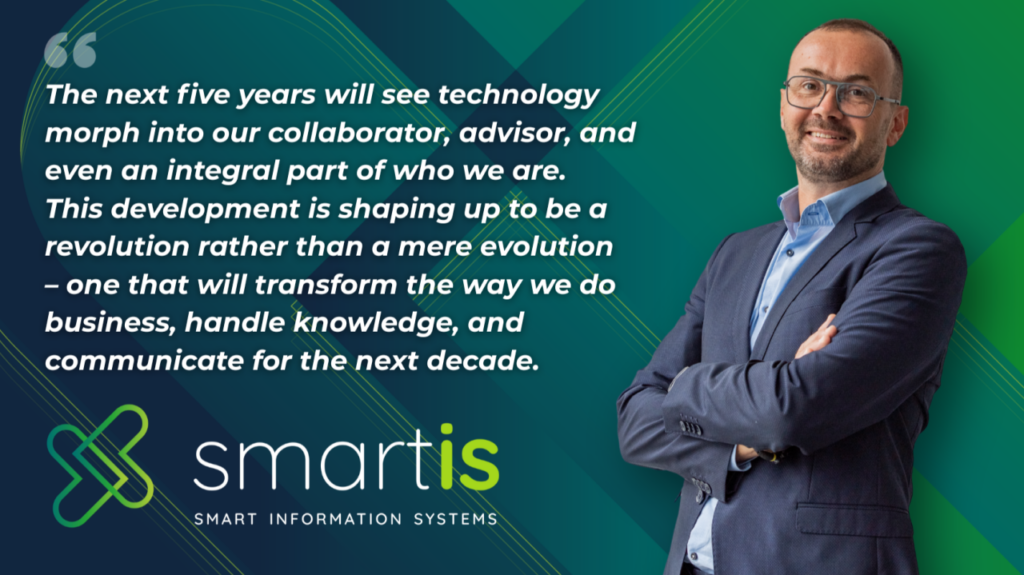
The next five years will see technology morph into our collaborator, advisor, and even an integral part of who we are. This development is shaping up to be a revolution rather than a mere evolution – one that will transform the way we do business, handle knowledge, and communicate for the next decade.To me, several trends stand out as crucial for shaping IT services, corporate business models, and our own day-to-day operations.
1. AI agents: fully autonomous automation of everyday tasks
The first such trend is AI agents, an advanced form of artificial intelligence that will allow us to fully automate our daily activities. No longer merely responding to questions and carrying out orders, AI agents can act autonomously, factoring in their environment and creating step-by-step plans to make decisions without human input. AI agents will be integrated into our corporate day-to-day operations and personal routines by taking on repetitive, time-consuming tasks.
2. Neuromorphic chips: superior performance meets energy efficiency
Neuromorphic chips are another groundbreaking trend. These chips mimic the human brain. This creates a twofold advantage: they provide unmatched computing power (the ability to rapidly perform complex operations and handle enormous volumes of data) while taking up much less space and slashing energy consumption.
This will allow us to move advanced functionalities much closer to the very edge of computing, enabling devices at remote locations to process vast amounts of data and use AI. At the moment, this is practically impossible due to energy-hungry tech and prohibitive costs. Computers capable of running AI remain incredibly expensive, consume tremendous amounts of energy and require centralised infrastructure.
Neuromorphic chips will change all of that. Smart devices – ranging from industrial sensors to medical devices and autonomous vehicles – will be capable of running advanced AI locally and responding in real time without having to rely on centralised data centres. This will bring down costs and reduce latency, opening up unprecedented opportunities for innovative services.
3. Quantum computing: a breakthrough carrying significant risks
The third trend is quantum computing. Though poised to drive great progress, the technology also comes with considerable risks. State-of-the-art cryptographic algorithms will no longer be unbreakable. This means that the encrypted data stolen today will no longer be secure in the future, as technology will allow for its decryption and weaponisation against us.
AI ENTERS THE DISINFORMATION BATTLEFIELD
Advances in AI are also bound to significantly worsen the impact of disinformation. We are already witnessing the proliferation of voice cloning, fake news and the manipulation of large language models (LLMs) for nefarious purposes. To combat this, it is vital to develop tools that can detect these phenomena as well as establish AI governance to ensure oversight of who has access to data and who uses AI – and to what end.
High labour costs and intense competition, especially from abroad, have pushed companies to come up with solutions.
Efforts are already underway in Europe to regulate data protection and the use of AI, although such measures can also reduce competitiveness. Despite this, tackling disinformation will be a key task of the future.
EFFICIENCY WILL MAKE OR BREAK INDUSTRY LEADERS
IT will play an even more decisive role than ever before. Some jobs are bound to be eliminated by AI. Companies will therefore have to adapt and optimise their operations. Therein lies an opportunity: by integrating AI agents into processes, optimising work and devising new business models.
Efficiency is what will separate the wheat from the chaff. High labour costs and intense competition, especially from abroad, have pushed companies to come up with solutions. Using the right tools can translate into efficiency gains. Information technology will be a cornerstone in this regard for both business operations and manufacturing processes. There is simply no alternative.
AI IN CYBERSECURITY
When it comes to cybersecurity, AI is something of a double-edged sword. On the one hand, it provides a tremendous opportunity: by detecting attacks or suspicious activity the moment they happen, it allows us to counteract them in real time. This will make defending against cyber threats faster, more precise and more effective than ever before.
On the other hand, however, that very same technology is also available to malicious actors. In their hands, it becomes a tool for increasingly sophisticated attacks as well as disinformation campaigns and user deception. The battle between the two has been and will continue to be relentless and ruthless.
The main opportunity provided by artificial intelligence is the rapid response time, or the ability to detect and neutralise threats as soon as they arise. Barring a few exceptions, however, this is something for the future, as counteracting threats is still predominantly done manually and remains rather slow. The future promises an entirely new level of defence, one built on speed and threat anticipation.
IT AS CRITICAL INFRASTRUCTURE
Information technology is the backbone of modern society. Without it, both the economy and everyday life would come to a grinding halt, debilitating both industry and the military. IT has come to be as indispensable as electricity, powering progress itself.
Yet this dependence leaves such technology incredibly vulnerable. Any part of it could be targeted, with every gap in the system being a potential entry point for attackers. IT plays multiple roles: it can be used both as a weapon and a shield, and at the same time, it is also an engine of progress. But while its uses may differ, the security principles behind them remain very much the same. A key emerging concept is “zero trust”, an approach that assumes no implicit trust, subjecting each and every individual to multiple checks before they are allowed access to your ecosystem. The new rule underpinning this approach states that trust must be earned, not given freely.
When it comes to cybersecurity, AI is something of a double-edged sword.
WHERE IS THE LINE WHERE THE PERSON ENDS AND THE TECHNOLOGY BEGINS?
Looking ahead, say to 2035, we can see a revolution take shape – one that will far surpass our current frame of reference – a revolution of neuroenhancement. Humanity will use technology to empower itself. Using minimally invasive procedures, we will be able to enhance our cognitive abilities, increase our IQ, improve healthcare, and even communicate without using words.
Imagine a world in which your job interview only takes a couple of minutes instead of an hour. Forget science fiction, this is our future reality. The real question will no longer be whether we have the technology for it, but rather how to use it, how to augment our knowledge and how to learn faster and more effectively.
The future of tech services is truly overflowing with challenges and opportunities. The key question that remains is how to manage risks and ensure security while harnessing the capabilities of the new era.
The future of tech services is truly overflowing with challenges and opportunities. The key question that remains is how to manage risks and ensure security while harnessing the capabilities of the new era.